Onde (Waves)

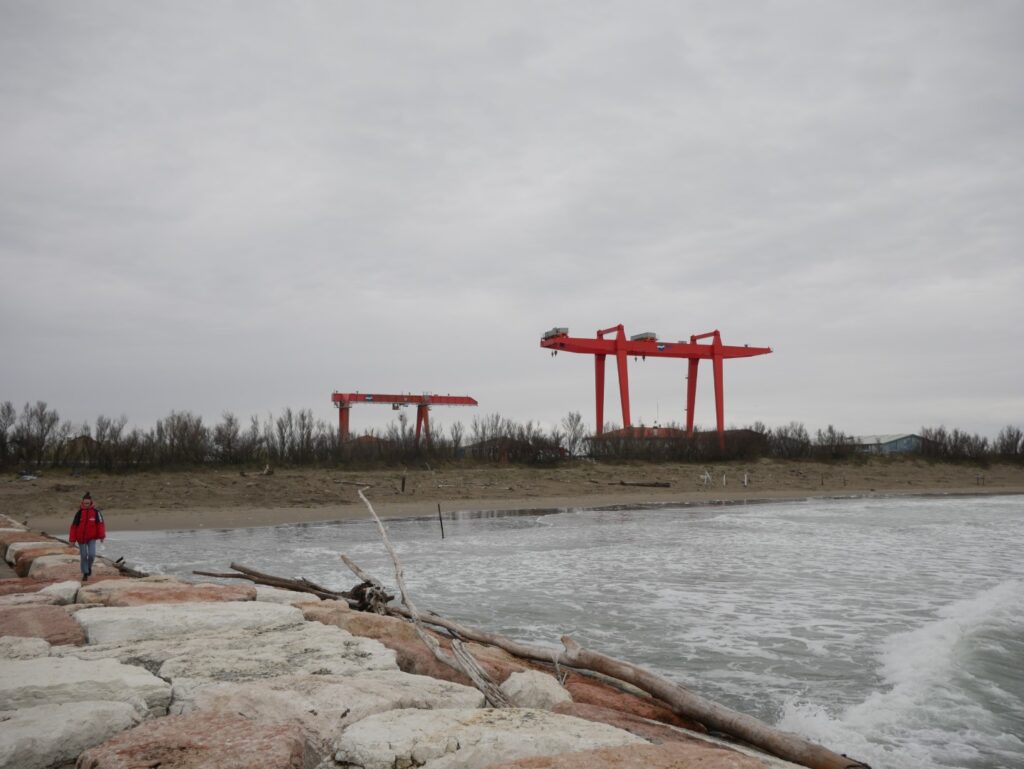
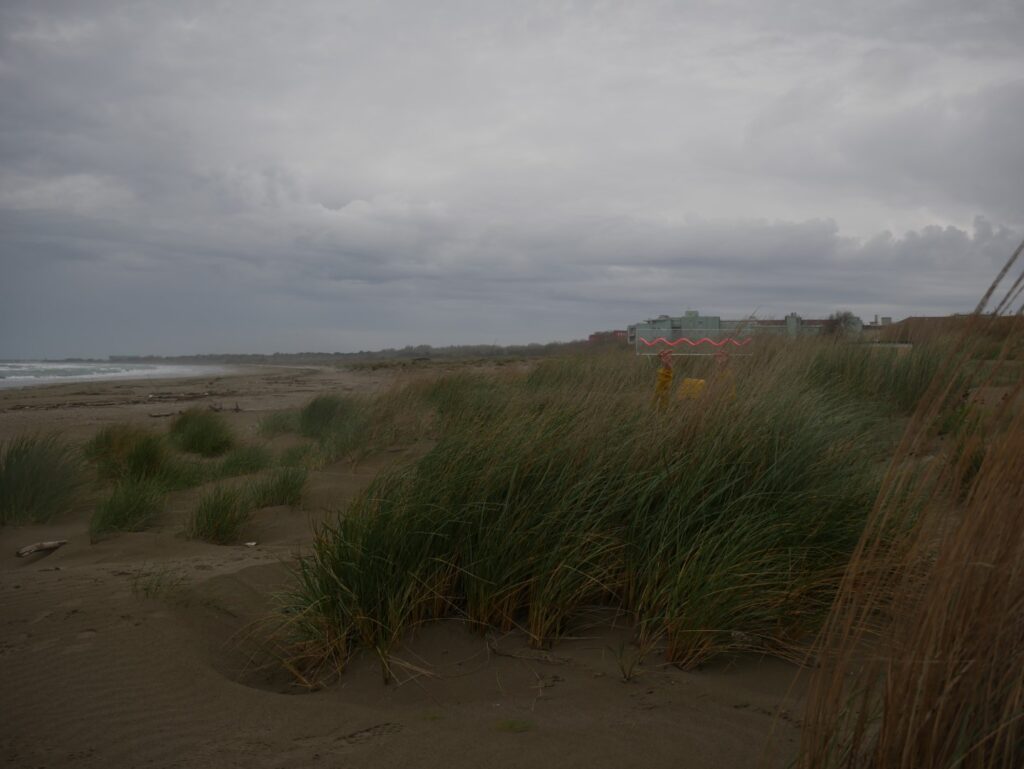
Onde (“Waves”) is a methodology of research through the act of walking, rather than a work of art in itself. The idea was inspired by the sister project Ziarah Utara, carried out by Tita Salina and Irwan Ahmett in Jakarta from 2018 onwards, in the context of the global program WE ARE OCEAN, curated by ARTPORT_making waves. The first walk was made possible by the MobilityFirst! Grant awarded by the Asia-Europe Foundation (ASEF) In an attempt to create a direct connection with the lagoon ecosystem, and specifically with the Murazzi of Lido and Pellestrina during the first walk, we created a small luminous mobile sculpture: a red wave that lights up in places charged with meaning, where the presence of the lagoon, the sea, or some of its particular inhabitants is perceived. It works by connecting to the past, perceiving the energy of the present or the possibility of future events. 

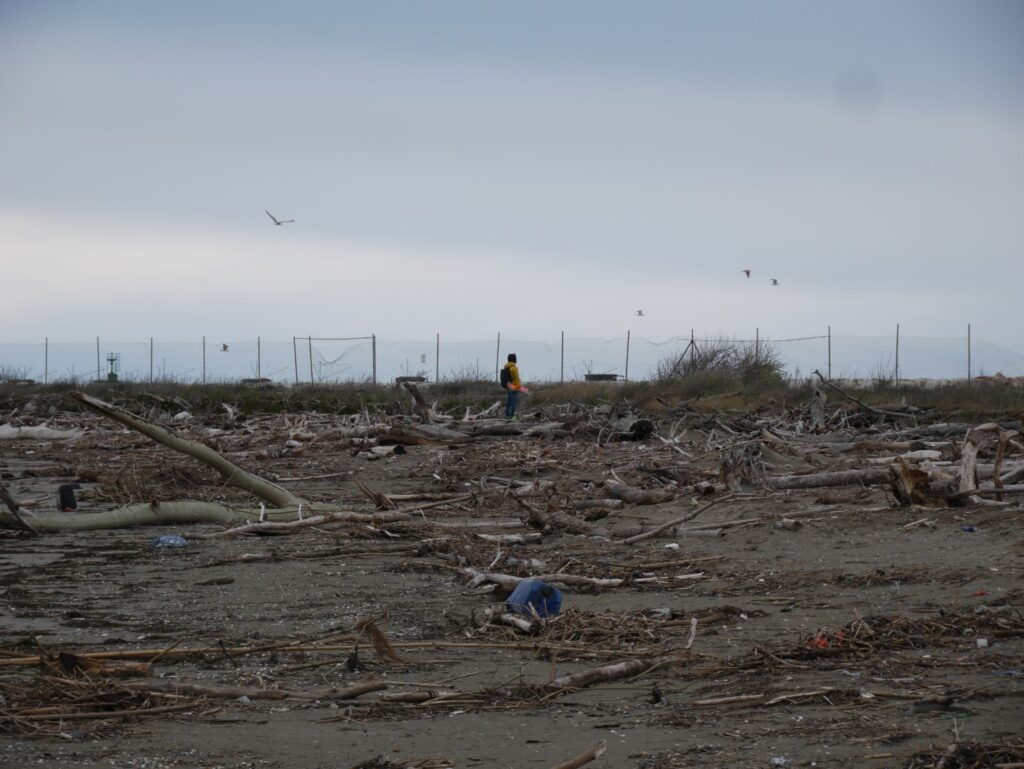
The light forced us to stop at some points to understand where this energy was coming from, to photograph it and understand it better. The slowness of walking is essential to be able to feel a territory through one’s body, unlike when crossing it quickly with other vehicles, and allows one to deviate, stop and retrace one’s steps. The light also served to meet people who are experts in the territory and ecosystem, connected to these places, learning from them and portraying them with the sculpture. 

By its nature, the project is longer in duration, lending itself to being repeated several times to understand changes in an area, broken into multiple sections, and used to learn from the inhabitants of these places. A first presentation of the exploration of the Murazzi was celebrated during World Earth Day, April 22, 2021, with a talk hosted by TBA21-Academy and Ocean Space with Tita Salina, Irwan Ahmett (from Jakarta), Åsa Andersson, Carl Michael von Hauswolff and curator of ARTPORT_making waves Anne-Marie Melster (Stockholm), creating a bridge between the three places connected by common issues. Next stops will be the Northern Lagoon, from Jesolo to Cavallino and inland, from Lova to Chioggia and an exploration of the saltmarshes in the Campalto area. 
How is it there? Here…

“How is it there? Here…”, part of the global program WE ARE OCEAN, is a critical geography workshop for the kids of Venice and for anyone around the world living with similar issues, such as environmental degradation of wetlands and growing pollution levels in both the air and the water, coastal erosion, subsidence and increasingly devastating floods. Irresponsible tourism development, depopulation of cities and lack of housing policies may also be of mutual interest. This is an invitation to care about each other, to think of our planet from the perspective of common threats and the potential to share solutions, rather than divide it into tiny clusters that compete with each other. It is developed by artist collective Barena Bianca as venetian iteration of the international project WE ARE OCEAN, commissioned and produced by ARTPORT_making waves with scientific support from We are here Venice and in collaboration with TBA21–Academy. The central focus is to send a message connecting apperently faraway places: talking about our home can mean also talking about a place on the other side of the world, if the threats we face are the same.

The workshop, initially designed to run during the lockdown period from Covid-19, evolved into an analogue format in the following year. While initially the prevailing format was that of ‘mail art’, with the involvement of two fourth-grade classes from the Benedetti Tommaseo high school in Venice, it was possible to develop the project into a didactic and interdisciplinary format. Similarly, the participants were invited to send a letter to Venice – or from Venice to a chosen place, elsewhere – describing why they are interested in the chosen place, why they are concerned, the hopes and dreams they might have for it, thus creating a connection between the place they are writing from and the place they are writing to. The conclusion and presentation of the workshop took place in the spaces of the CNR Ismar in Venice during the Global Program “We Are Ocean” curated by Artport Making Waves.

The digital map created together with the artist Donato Spinelli archives the letters collected during the project.

Barena Primavera-Estate

Barena Primavera-Estate was a workshop developed in collaboration with Giorgia Cereda and produced and coordinated by We Are Here Venice. During the World’s Ocean Day, 20 Venetian kids recycled old shirts, about to be abandoned, in order to become living symbols of the Lagoon. Each kid composed his own image on the clay tablet before stamping it on the shirt, using plants and flowers from the Barene, giving life to a personal interpretation of the Lagoon’s ecosystem. The video, through the voice of Francesco Da Mosto – Venetian architect, historian and BBC presenter – that accompanies images from the workshop and the exploration of the Barene of Campalto, purposely mocks the style of a commercial that does not seek to sell anything. Rather, the “mock-mercial” strives to encourage to adopt a set of ideals necessary in order to tackle the downwards spiral of the Venetian ecosystem, in which both the resident population and the amount of Barene declined of about 70% during the last century. Each of us can be a Barena.

Muevete Muevete Barena

Muevete Muevete Barena was a didactic happening produced by We Are Here Venice that took place in Venice from Palazzo delle Zattere (V-A-C Foundation) to Campo Santo Stefano. 60 venetian children (fifth grade of Scuola Elementare B. Canal) were invited to realize a festive parade bringing with them a 30-meters long “anti-mimetic” textile support with a pattern realized from the Barene in Campalto. Refusing to surrender to exploitative logics leading to ecological and sociological downfall, fighting not to disappear, the autochthonous kids – almost an exotic species to tourists and visitors, who live Venice as a dead city and open-air museum – gave life to a metaphorical mythical animal of the lagoon appearing in a crossway of Venice’s touristic center (North to Rialto, East to San Marco) Once in Campo Santo Stefano, three big collective drawings were realized by the children, portraying elements of the venetian lagoon with chalks in frames composed by the Barena squares through a deconstruction and reconstruction of the textile.